Vote Abstention in Swiss Referendums

Reason of existence
Explanation of idea
This document analyzes the need for an application to increase the share of votes in Switzerland.
This report should help to understand whether the idea of creating a mobile application will increase the share of votes and conclude if the given idea should be designed and planned.
Dataset
This report exclusively uses datasets provided by the Swiss government. The data is retrieved using the available open-source APIs.
To be exact, the following API is the main source of truth for the entirety of this report: Swiss OpenData (opens in a new tab)
Current Situation in Switzerland
Personal feeling
Seeing the current share of votes is quite devastating. Roughly 50% of eligible voters vote on important topics.
Especially, it seems like young people are not voting on topics, and it also seems like titles for initiatives are beautified. The so-called "Erbschaftsinitiative" was called "Initiative fur die Zukunft," which basically changes human interpretation of the topic to be voted on.
Data-driven analysis
General turnout (1980-2025)
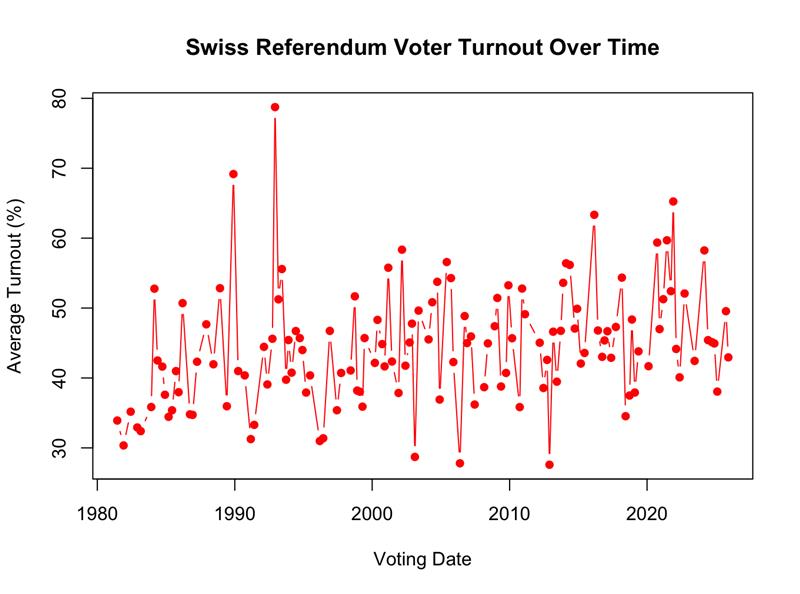
Using the open-source API provided by the Swiss Confederation, we were able to analyze the share of votes from 1980 until 2025. As shown in this graph, turnout has been surprisingly low since the 1980s, with a few exceptions where peaks are visible.
As a next step, we take a closer look at the topics that generate higher turnout and those that tend to result in lower turnout.
Closer look at high-turnout initiatives
After reviewing the general turnout, the dataset was filtered for all votes with turnout higher than or equal to 50%. In total, the analysis returned 29 referendums from 1980 until 2025 that exceeded a turnout of 50%.
Eight of these were analyzed in detail, especially the initiative with the highest turnout of 78.73% in 1992. The title of this initiative was "Bundesbeschluss uber den Europaischen Wirtschaftsraum (EWR)," which was denied with only 50.3%.
Also, elections like "Marriage for all" from 2021 resulted in a higher turnout of 52.6%.
Therefore, no single direct connection between these topics can be confirmed. However, what can be said is that high-turnout topics are generally those that are internationally relevant and do not affect only Switzerland, but a broader context.
Possible way to increase turnout
The primary objective of the organization is to promote political literacy among individuals from an early age.
Generation Z and Generation Alpha are often called the "Dopamine Generation" due to increased online gambling, addiction to social media platforms, and intense gamification. Generally, this effect of online use is not supported by the organization nor by parts of the general population in different countries, such as Australia, where social media use is banned for everyone under the age of 16.
However, the organization believes that this same dopamine effect can be used for educational purposes. A gamified educational landscape can shape teenagers' ability to understand political topics. This effect should be studied and used to increase vote turnout.
Letting teenagers engage with the open political landscape in a gamified way could create interest at a young age. As a positive side effect, an increase in voting turnout is expected.
Chances and Risks
The following tables show chances and risks of using dopamine-driven gamification to increase voter turnout among young individuals.
Chances
| Title | Explanation |
|---|---|
| Increase of turnout | Increasing vote turnout should be a goal to ensure a more inclusive vote. |
| Interest in young age | By including the application in compulsory school, teenagers can develop political interest at a young age and potentially pursue a faster political career. |
Risks
| Title | Explanation |
|---|---|
| Risk of addiction | As gamification can produce dopamine, there is a possibility that younger individuals could become addicted to the tool. |
Action plan
- Creation of mockups
- Decision on hosting methods
- A decision must be made regarding which cloud should be used.
- As the goal includes securing a government contract, Swiss hosting options should be prioritized due to Swissness and data privacy concerns in education and political topics.
- Creation of MVP
- Creation of authentication module
- For private users: Google, Apple, and Microsoft login is a must.
- For educational users: Needs evaluation by canton; Switch Edu-ID should be implemented due to its use by Swiss universities.
- Transfer from MVP to full application
- Release for private consumers
- Pitch for educational institutions
- Educational institutions launch